



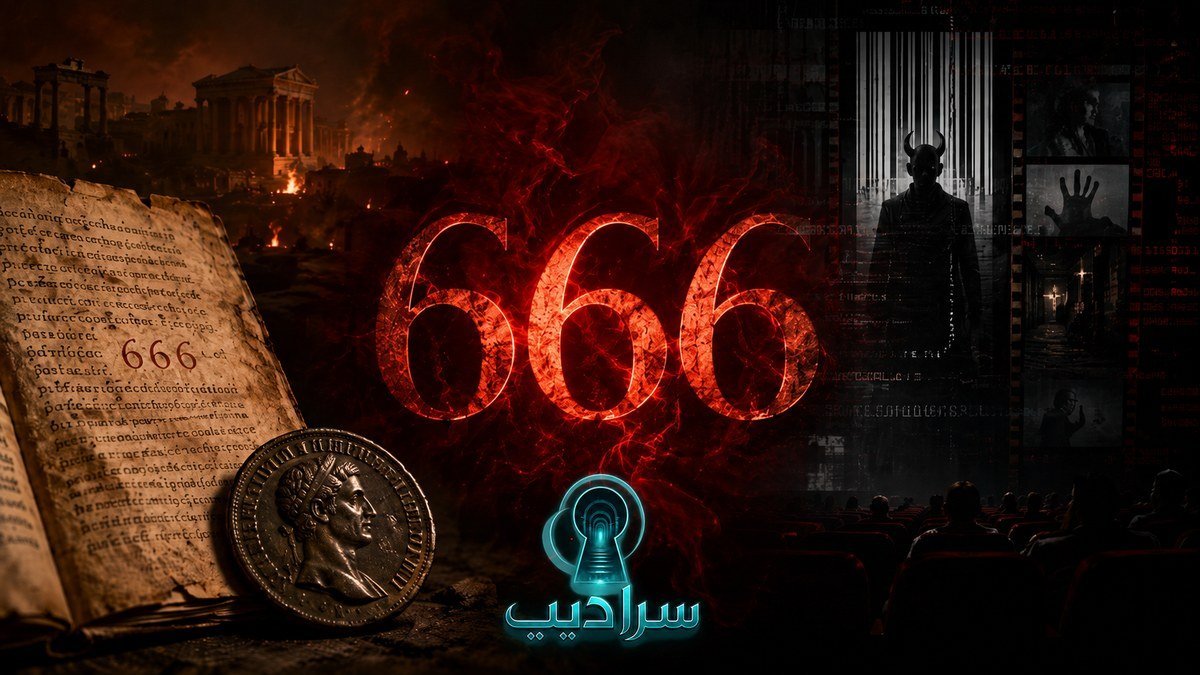
Quick summary
- نادراً ما حاز رقم عادي كل هذا الخوف والجدل مثل الرقم 666.
- يكفي أن يظهر في فيلم، أو على لوحة سيارة، أو ضمن رقم هاتف، حتى يراه بعض الناس علامة على الشر.
- في المقابل، يتعامل معه آخرون باعتباره رقماً عادياً صنعت له الأديان والتفسيرات الشعبية والسينما سمعة مرعبة.
NavigationIn this article
نادراً ما حاز رقم عادي كل هذا الخوف والجدل مثل الرقم 666. يكفي أن يظهر في فيلم، أو على لوحة سيارة، أو ضمن رقم هاتف، حتى يراه بعض الناس علامة على الشر. في المقابل، يتعامل معه آخرون باعتباره رقماً عادياً صنعت له الأديان والتفسيرات الشعبية والسينما سمعة مرعبة.
وعندما نرجع إلى أقدم المصادر، نجد أن القصة أبسط وأهدأ مما توحي به أفلام الرعب. فالرقم لم يظهر أول مرة كتعاويذ سحرية، ولم يكن مفتاحاً لاستدعاء الجن أو فتح بوابة إلى عالم خفي. لقد ورد في نص مسيحي رمزي، ثم تراكمت حوله تفسيرات دينية وثقافية أبعدته تدريجياً عن سياقه الأصلي.
أين ظهر الرقم لأول مرة؟
من المهم أن نميز منذ البداية بين ظهور العدد 666 بوصفه كمية عادية، وبين ظهوره بوصفه «عدد الوحش».
العدد نفسه أقدم من المسيحية بطبيعة الحال، كما ورد في أسفار العهد القديم قبل سفر الرؤيا بقرون. يذكر سفر الملوك الأول، مثلًا، أن وزن الذهب الذي كان يصل إلى الملك سليمان في سنة واحدة بلغ ستمئة وستة وستين وزنة. ويظهر العدد أيضًا في سفر أخبار الأيام الثاني، كما يرد في سفر عزرا عند تعداد أفراد إحدى العائلات.
هذه المواضع لا تقول إن الرقم شيطاني، ولا تمنحه قوة غيبية. إنه فيها مجرد مقدار للذهب أو عدد للأشخاص. ولهذا فقول إن 666 «نشأ بوصفه رقمًا للشيطان» ليس دقيقًا.
أما ظهوره الشهير بوصفه «عدد الوحش» فجاء في الإصحاح الثالث عشر من سفر رؤيا يوحنا، آخر أسفار العهد الجديد. والسفر مكتوب باليونانية وينتمي إلى أدب الرؤى، وهو نوع من الكتابة كان يستخدم الأحلام والمخلوقات الغريبة والأرقام والصور الكونية للتعبير عن صراعات دينية وسياسية حقيقية.
ينسب النص نفسه الرؤيا إلى رجل يدعى يوحنا كان موجودًا في جزيرة بطمس، قبالة الساحل الغربي لآسيا الصغرى، أي ضمن أراضي تركيا الحالية. ولا يوجد اتفاق كامل بين الباحثين على أن هذا الكاتب هو يوحنا الرسول نفسه، ولذلك يطلق عليه كثير من الدارسين ببساطة اسم «يوحنا البطمسي» أو «يوحنا صاحب الرؤيا».
يؤرخ معظم الباحثين سفر الرؤيا إلى أواخر القرن الأول الميلادي، قرابة سنة 95 في عهد الإمبراطور دوميتيان، مع وجود رأي آخر يضعه في أواخر عهد نيرون أو بعد موته بقليل، أي في أواخر ستينيات القرن الأول. هذا الاختلاف مهم، لكنه لا يغير حقيقة أن السفر كُتب في عالم خاضع للإمبراطورية الرومانية، وأن جمهوره الأول كان مجموعة من الكنائس في مدن آسيا الصغرى.
السياق الذي ظهر فيه «عدد الوحش»
في الإصحاح الثالث عشر تظهر صورتان رمزيتان. الأولى وحش صاعد من البحر، له سلطة واسعة ويتلقى قوته من «التنين». ثم يظهر وحش آخر من الأرض، يدفع الناس إلى عبادة الوحش الأول، ويجري آيات مضللة، ويفرض علامة على اليد اليمنى أو الجبهة، بحيث لا يستطيع من لا يحمل العلامة أن يبيع أو يشتري.
بعد ذلك يدعو النص القارئ إلى استخدام الحكمة وحساب عدد الوحش، لأنه «عدد إنسان»، ويعطيه على أنه ستمئة وستة وستون. وتشير بعض الترجمات الحديثة في هامش الآية إلى أن مخطوطات قديمة أخرى تقرأ ستمئة وستة عشر. يمكن مراجعة النص واختلاف القراءة في سفر رؤيا يوحنا، الإصحاح الثالث عشر، الآيات 11 إلى 18.
وهنا تفصيل مهم غالباً ما تغفله الأفلام والمنشورات الشعبية: النص يتحدث عن العدد ستمئة وستة وستين، لا عن ثلاث ستات منفصلة تعمل كتسلسل سحري. كما أنه لا يصف الرقم كتعاويذ، ولا يقول إن كتابته تستدعي كائناً خارقاً.
كذلك لا يقول النص صراحة إن 666 هو «رقم الشيطان». الرقم هو عدد الوحش أو عدد اسمه. ومع ذلك، توجد علاقة دينية واضحة بين الوحش والشيطان داخل قصة السفر، لأن «التنين» الذي يمنح الوحش سلطته يُعرَّف في الإصحاح السابق بأنه الحية القديمة وإبليس والشيطان. لهذا ارتبط الوحش لاحقًا بالشيطان في العقيدة والمخيلة المسيحية، لكن وصف 666 بأنه رقم الشيطان مباشرة هو اختصار شعبي لا ينقل العبارة الأصلية بدقة.
والعلامة نفسها ليست موصوفة بالضرورة على أنها الأرقام 6 و6 و6 مكتوبة على الجلد. يقول النص إنها اسم الوحش أو عدد اسمه، وقد يفهمها بعض المفسرين كعلامة حرفية، بينما يراها آخرون رمزًا للولاء السياسي والديني. أما صورة الطفل الذي يولد وعلى رأسه وشم 666، كما تظهر في بعض أفلام الرعب، فهي إضافة سينمائية وليست وصفًا موجودًا في سفر الرؤيا.
لماذا يُربط الرقم بالإمبراطور نيرون؟
أقوى تفسير تاريخي للرقم، والأوسع قبولًا بين دارسي سفر الرؤيا، هو أنه شفرة تشير إلى الإمبراطور الروماني نيرون. ويرتبط هذا التفسير بطريقة قديمة في الحساب كانت تُعطى فيها الحروف قيمًا عددية. وعندما تجمع قيم حروف اسم شخص، تحصل على عدد يمكن استخدامه بدلًا من التصريح باسمه.
كانت هذه الممارسة معروفة في العالم القديم، وتسمى في السياق اليوناني أحيانًا «حساب الحروف»، بينما تشتهر اليوم باسم الجُمَّل أو الجيماتريا.
عند كتابة لقب «نيرون قيصر» بصيغة عبرية قريبة من النطق اليوناني، يصبح:
נרון קסר — نيرون قيسر
وتكون القيم العددية للحروف على النحو الآتي:
50 + 200 + 6 + 50 + 100 + 60 + 200 = 666
ليست قوة هذا التفسير في أن اسم نيرون يمكن جعله يساوي 666 فقط؛ فباستخدام لغات وطرق تهجئة متعددة يمكن تركيب أسماء كثيرة لتناسب أرقامًا مختلفة. ما يجعل تفسير نيرون أقوى من معظم التخمينات هو أنه يفسر أيضًا القراءة القديمة الأخرى: 616.
في اللاتينية يُكتب الاسم «نيرو» بدل الصيغة اليونانية «نيرون». وعند حذف حرف النون الأخير، الذي تبلغ قيمته خمسين، يصبح الحساب:
666 − 50 = 616
وهكذا يمكن للقراء الذين يستخدمون الصيغة اليونانية للاسم أن يعرفوا العدد 666، بينما يحصل من يستخدمون الصيغة اللاتينية الأقصر على 616. هذا التوافق بين شكلَي الاسم واختلاف المخطوطات هو أحد أقوى الأدلة لمصلحة تفسير نيرون. وتشير مراجع أكاديمية إلى وجود توافق واسع على أن شفرة الاسم في الآية تتجه نحو نيرون، وإن لم يكن ذلك أمرًا محسومًا بلا خلاف؛ انظر كتاب The Cambridge Companion to Apocalyptic Literature، في الفصل المخصص لمقدمة سفر الرؤيا.
كان نيرون قد حكم بين عامي 54 و68 للميلاد. وبعد حريق روما سنة 64، اتُّهم المسيحيون وأُعدم عدد منهم بطرق قاسية. ويبدو أن تلك الأحداث كانت محصورة في روما أكثر من كونها حملة شاملة في كل الإمبراطورية، لكنها جعلت نيرون في الذاكرة المسيحية المبكرة نموذجًا للحاكم المضطهد.
وبعد موته انتشرت شائعات تقول إنه لم يمت فعلًا، أو إنه سيعود ليستعيد حكمه. عُرفت هذه الفكرة لاحقًا باسم أسطورة «نيرون العائد». وقد تساعد في تفسير صورة الوحش الذي تلقى جرحًا قاتلًا ثم شُفي، أو الذي «كان وليس الآن وسيعود» في موضع لاحق من السفر.
إذا كان سفر الرؤيا قد كُتب في عهد دوميتيان، فهذا لا يمنع الإشارة إلى نيرون. فقد يكون نيرون تحول بحلول ذلك الوقت إلى رمز للطغيان الروماني، واستُخدم اسمه المشفر للتحذير من عودة الاضطهاد في صورة إمبراطور آخر. وبذلك لا يكون الوحش مجرد فرد واحد، بل صورة لنظام سياسي يطالب الناس بولاء مطلق يكاد يصل إلى العبادة.
ماذا يعني اختلاف 666 و616؟
النسخ الأصلية لأسفار العهد الجديد لم تصل إلينا، وإنما وصلت مخطوطات نُسخت يدويًا على مدى قرون. ومن الطبيعي أن تظهر بينها اختلافات صغيرة بسبب أخطاء النسخ أو اختلاف القراءة أو محاولات التوضيح.
القراءة الموجودة في أغلب المخطوطات والمعتمدة في النصوص النقدية الحديثة هي 666. لكن القراءة 616 قديمة أيضًا وليست اختراعًا حديثًا. تظهر في مخطوطة البردي المعروفة باسم P115، وهي واحدة من أقدم الشواهد الباقية على هذا الجزء من سفر الرؤيا، كما تظهر في مخطوطات وشهادات نصية أخرى.
Here is a natural and accurate translation of the paragraph into English: "Most importantly, Irenaeus, Bishop of Lyon, was aware of the 616 reading in the second century AD—that is, before the earliest complete manuscripts that have come down to us. Around the year 180, he wrote that the copies he trusted bore the number 666, and he considered 616 to be an error made by some scribes. Nevertheless, he warned against rushing to declare the name of the person represented by the number, because many names can be calculated to arrive at the same sum. His discussion can be read in Irenaeus’s book *Against Heresies*, Book 5, Chapter 30."
يرى بعض الباحثين اليوم أن 616 لم ينتج عن خطأ عشوائي، بل قد يكون تعديلًا مقصودًا ليناسب الصيغة اللاتينية لاسم نيرون. فإذا صح ذلك، يصبح اختلاف المخطوطات شاهدًا على أن القراء الأوائل كانوا يفهمون الإشارة إلى الإمبراطور ويكيّفونها مع لغة الاسم التي يعرفونها.
ومع هذا تبقى هناك تفسيرات أخرى. فقد اقترح بعض الباحثين أسماء مثل «لاتينوس» أو «تيتان»، بينما ربط آخرون الرقم بما ورد عن ذهب سليمان في العهد القديم، بوصفه رمزًا للثروة والاستغلال والانحراف السياسي. وقد نوقشت فرضية سليمان حديثًا في دراسة نشرتها دراسة «Solomon and 666» المنشورة في مجلة New Testament Studies التابعة لجامعة كامبريدج. لكن تفسير نيرون يظل الأقوى تاريخيًا لأنه يشرح الرقمين 666 و616 معًا، ويناسب السياق الروماني للنص.
كيف فهم المسيحيون الرقم عبر العصور؟
لم يكن للمسيحيين تفسير واحد ثابت للرقم. فكل عصر قرأ سفر الرؤيا من داخل ظروفه ومخاوفه.
Here is a natural and accurate translation of the paragraph into English: Some early Christians saw the Beast as a symbol of the Roman Empire or an oppressive ruler, while others associated it with a figure who would appear at the end of time. Over time, various imagery from different texts was combined: the Beast in the Book of Revelation, the "Antichrist" mentioned in the Epistles of John, and the "Man of Sin" in the Second Epistle to the Thessalonians. From this combination, the common Christian image of the False Messiah, or the Antichrist, was formed.
Here is a translation of the paragraph into English: "It is necessary here to clarify a point that often confuses people: the phrase 'Antichrist' does not appear in the Book of Revelation itself. The connection between this name and the beast comes from a theological interpretation that combines various Christian texts, rather than from an explicit statement saying that the beast is the Antichrist and that his name is 666."
Here is a translation of the paragraph into English: In the Middle Ages, numbers became a tool for interpreting historical events. People would calculate the names of kings, leaders, and religious opponents in search of the person who matched a specific number. During times of sectarian conflict, Christian groups accused their opponents of being the Beast; some Protestants saw the Papacy as the fulfillment of the prophecy, while some Catholics retaliated by applying similar symbols to their own opponents. Often, the calculation would begin with the desired outcome, after which the language and spelling of the name would be chosen so that the total would add up to 666.
Here is the English translation of the paragraph: "In the modern era, several main trends have emerged regarding the interpretation of the number. There are those who see it as a historical reference to Nero and Rome, those who see it as a recurring symbol for any authority that demands loyalty conflicting with faith, and those who believe it relates to a global ruler who will appear in the future and impose an economic mark on humanity."
Here is a translation of the paragraph into English: "As for the belief that the number represents imperfection because it is less than seven, and that repeating the six three times means the peak of imperfection, this is a common symbolic and homiletical interpretation. It might seem fitting because seven is an important number in the Book of Revelation, but it is not an interpretation explicitly stated by the text. Moreover, the number in the original is six hundred and sixty-six, not three separate words each meaning six."
Hence arise modern fears that ID cards, bank cards, barcodes, electronic chips, or digital currencies might be "the mark of the beast." These are contemporary religious interpretations based on linking the phrase about buying and selling to new technologies. However, this is information not found in the ancient text, which mentions no device, chip, barcode, or specific type of technology.
Is 666 the number of the devil in Christianity?
In traditional Christian belief, the beast is part of the camp of evil and derives its authority from the dragon, which represents the devil. Therefore, it is religiously understandable that the number has become associated with the devil and the Antichrist.
Yet, when strictly adhering to the text, it must be said that 666 is "the number of the beast" and "the number of a man," neither a secret name for the devil nor a number that grants the devil his power. Furthermore, the beast in Revelation represents an anti-God force, which may be understood as a person, a state, a system, or a symbol that repeats throughout history, depending on the school of interpretation followed.
Thus, the relationship to the devil exists within Christian belief, but it is a narrative and theological relationship, not a magical one that makes the number itself an influential entity. Seeing the number on an invoice or a license plate does not mean, even according to the Christian text, that evil has arrived at that place.
What does Islam say about the number 666?
The number 666 does not appear in the Quran or authentic Hadiths as a symbol for the devil, jinn, the Antichrist, or magic. Nor is there any known eschatological sign in Islamic doctrine bearing this number.
Some internet content may attempt to construct the number using surah and verse numbers, such as writing "66:6," but this signifies the sixty-sixth surah and the sixth verse, not the number six hundred and sixty-six. Aggregating numbers in this manner is a modern visual game with no evidence that it carries any hidden religious meaning.
Islam acknowledges the existence of Jinn, but it does not make all Jinn demons. The Jinn in the Quran are accountable creatures; among them are believers and others, as shown in Surah Al-Jinn, verses 1 to 14. As for the demons (Al-Shayatin), they are the rebels and the agents of enticement, and it is incorrect to use the words "Jinn" and "Demon" as if they are always names for the very same thing.
Similarly, the Quran mentions magic and warns against it, presenting it as a gateway to harm, tribulation, and deviation, as in Surah Al-Baqarah, verse 102. It also criticizes seeking protection from the Jinn in Surah Al-Jinn, verse 6, because a Muslim is commanded to turn to God rather than to hidden entities.
However, belief in the existence of magic or Jinn in Islam does not mean that every folk story about them is true. There is no Islamic basis for the idea that writing 666 summons the Jinn, that repeating it opens a portal, or that its accidental appearance is proof of a satanic covenant. Furthermore, the Islamic worldview does not grant numbers an independent power to benefit or harm, and it rejects pessimism rooted in superstitions and random signs.
If a person intentionally uses the number within an esoteric ritual or a declaration of evil worship, the religious problem lies in the belief, intention, and practice, not in the three digits written on paper. A number found in a commercial account, an address, or a product code does not transform by itself into a talisman.
Aleister Crowley and the Adoption of the Persona of "The Beast 666"
Aleister Crowley, born in 1875 and died in 1947, was one of the most prominent figures of modern Western esotericism. He grew up in an intensely conservative Christian family belonging to the Plymouth Brethren, then rebelled against the religious environment of his upbringing and turned toward ritual magic and esoteric mysticism.
Crowley founded a religious and magical system known as "Thelema," and adopted the title "The Great Beast 666." His use of the number was not merely a passing detail; he made it a part of his public identity, his writings, and his deliberate image as someone defying traditional Christian morality.
However, simply describing Crowley as a "Satan worshipper" does not provide an accurate historical picture. He did not deal with symbols according to traditional Christian doctrine; rather, he reinterpreted them within his own esoteric system, sometimes using them for provocation and to declare rebellion. Sensationalist journalism contributed to portraying him as the most dangerous magician of his era, while he himself contributed to crafting and profiting from this reputation. Modern studies show that he adopted the identity of the "Beast 666" since his early rebellion against his religious upbringing; see the study published in the journal *Aries*, which specializes in the history of Western esotericism.
The significance of Crowley in the story of the number lies in the fact that he moved 666 from the pages of religious commentary into a declared esoteric identity. When a famous magician chooses to call himself the Beast, it becomes entrenched in the public mind that the number is a genuine tool of magic, even if its original use was symbolic, personal, and provocative.
Afterward, other groups and artists adopted the number to announce their rejection of Christianity, challenge society, or forge a shocking image. In many cases, this usage did not stem from a belief in the power of the number, but rather because it was the quickest symbol through which the Western public could recognize the idea of evil or the taboo.
How did cinema and horror culture seize the number?
Cinema was one of the most important factors in shaping the contemporary image of the number. Horror films presented 666 as a physical mark of the Antichrist, or a seal appearing on an evil child or the victim of a curse. Among the most famous examples is the 1976 film *The Omen*, where the number appears on the scalp of the child Damien as a sign revealing his demonic identity.
This image is cinematically powerful, but it does not appear in this form in the Book of Revelation. The text does not say that the Antichrist is born with the number on his head; rather, it speaks of a mark imposed within the context of allegiance to the beast and the ability to buy and sell.
After that, the number entered the world of rock and metal music, album covers, apparel, and video games. It began to be used sometimes to evoke fear, sometimes for irony, and sometimes to build a rebellious identity. Iron Maiden's famous 1982 album, *The Number of the Beast*, cemented the phrase's presence among an audience far broader than the community of religious studies.
With repeated use, the meaning of the symbol changed in the public consciousness. Many people no longer knew anything about Nero, the Roman Empire, or the discrepancy of 616, but they immediately knew that the appearance of 666 in a film meant that something demonic was about to happen.
In this way, popular culture creates its symbols: it takes a complex idea, condenses it into a simple image, and then repeats it until, in people's minds, it seems older and more deeply rooted than its true origin.
The Internet and the Industry of New Myths
The internet granted the number a new life. Clips and posts appeared claiming that it is secretly present in barcodes, in the abbreviation of the World Wide Web (WWW), or in the names of corporations, currencies, vaccines, and identification numbers. Every time a new technology emerges, some people try to link it to the mark of the beast.
However, these claims usually rely on cherry-picking a convenient method of calculation while ignoring other methods. Letters can be converted into numbers according to Hebrew, Greek, or English; a name's spelling can be altered, or words omitted and titles added. With this degree of flexibility, reaching 666 becomes possible in many unrelated names.
Saying that WWW equals 666, for example, relies on equating the letter W with the Hebrew letter "Vav," which has a value of six, and then repeating it three times. Yet, W is a modern Latin letter and not three Hebrew letters, and there is no historical reason that mandates the use of this specific rule.
The same applies to the barcode claims. The separating lines in the code have a technical function, not a secret announcement of 666. The resemblance of certain shapes does not prove the existence of a hidden religious message.
As for the stories claiming that writing the number inside a circle opens a gateway to the jinn, that repeating it at midnight makes a pact with the devil, or that a house bearing the number 666 becomes haunted, they have no basis in the Book of Revelation nor in Islamic sources. They are elements from horror movies, challenge games, and internet stories known as "Creepypasta."
There is also no such thing as 6:66 in the usual temporal sense; when the minutes reach sixty, a new hour begins. Yet the phrase "the 6:66 hour" appears in stories because it sounds frightening, not because it represents a real time.
Coincidence and selective attention help perpetuate these beliefs. Whoever fears the number begins to notice it on price tags, license plates, and phones, while ignoring the hundreds of other numbers they saw during the day. The more their fear of it grows, the more they search for it, making them feel as though it is hunting them, even though what has changed is their attention, not the world around them.
The number also has neat mathematical properties; it is the sum of the numbers from 1 to 36. Moreover, adding the fundamental values of certain Roman numerals yields 666. However, the presence of mathematical patterns in a number does not grant it supernatural power; numbers are full of relationships and patterns that can be discovered if we search hard enough.
Three layers that must not be mixed
What remains textually and historically consistent is that the number appeared in the Book of Revelation of John as the number of the beast and the number of a man, within an apocalyptic Christian text written in an environment subject to the Roman Empire. Furthermore, the manuscripts differ between 666 and 616, and this discrepancy has been known since the second century. The strongest historical interpretation links the number to the name of Nero Caesar through letter-value numerology (gematria).
Religious belief and subsequent interpretation involve linking the beast to Satan or the Antichrist, the belief in the appearance of a sign at the end of times, and determining whether the sign is literal or symbolic. These matters belong to Christian doctrines and exegetical schools, and not all Christians agree on their details. As for Islam, it believes in the existence of jinn and warns against magic, but it does not grant the number 666 any special religious status.
Legend and popular imagination encompass the notions that the number is an amulet that opens the gates of evil, that repeating it summons jinn, that it appears on the body of the Antichrist from birth, or that it is necessarily hidden within every barcode and modern technology. These perceptions originated primarily from modern esotericism, cinema, horror music, conspiracy theories, and internet content.
Conclusion
The number 666 did not begin as a key to black magic, but rather as a number within a symbolic religious text. Historically, it is likely that it was a code understood by certain first-century readers, referring to Nero or to the Roman authority he embodied. As for its discrepancy with 616, it is not a scandal concealed by the churches, but rather a known manuscript variant openly studied by scholars, and it may in itself serve as additional evidence for the interpretation of Nero's name.
Connecting it to Satan is understandable within the evolution of Christian belief, because the beast in the Book of Revelation stands on the side of evil and receives its authority from the dragon. However, this does not make the number itself a living force or a magical tool.
In Islam, the number has no special meaning. Belief in jinn and magic does not justify transferring every story that appeared in a film or an anonymous post into the sphere of doctrine.
What we see today is the result of a long accumulation: an ancient apocalyptic text, theological interpretations, political and sectarian disputes, esoteric figures such as Aleister Crowley, followed by films, music, games, and conspiracy theories. With each new layer, the number moved one step further away from its initial context and closer to its current image as a shorthand symbol for everything demonic and terrifying.
In the end, 666 remains a number like any other. It opens no door, summons no jinn, seals no pact, and causes no harm simply by being written or appearing by coincidence. All of its power comes from the meanings accumulated around it by religious interpretations, stories, cinema, and man's natural fear of mysterious symbols.
Sources mentioned in the article:
Author: Saradeeb Team
Have a thought or question about this article?
Continue the conversation in the community and share your ideas with readers and writers.

Comments 0
Share your thoughts respectfully. Abusive or disruptive comments may be hidden.